Showing posts with label student projects. Show all posts
Showing posts with label student projects. Show all posts

SUBURB AS ALTERITY
Open publication - Free publishing - More thesis
Because I'm just about there...an architectural thesis from the ever-intriguing Nick Axel whose name may ring a bell as the architect behind the aphoristic 'Architecture is...' project. (Worth a look!)
In the thesis project his ability to travel from quite complex theoretical ideas (in this case, alterity), through design processes to a specific design outcome which has plausible consequences for a real scenario is once again on display.
15

Drawings from my final project for 4th Year
- a music and film school -
featured on the draftery this week.
(Thank you Jensen!)
UNDER/OVER

Tatiana M Vela Jara
· · · Hand drawings are explorations and processes of the project itself. They can capture in one space the past, present and possible experience of an idea - an idea that itself has come out of the first few drawn lines. In this way, particualarly the hand-made drawing can reveal the maker's attitude and complexity, energy or vigour - and how it relates to the project itself. These drawings are mainly drawn by hand in various layers and various methods: pencil drawing, collage and hand cut outs of photographs. Photoshop was used minimally to obtain contrasts and layering - adding textures only when necessary. The drawings intend to show the contrast of very different worlds: overground and a secretive underground. Layers are intended to be shown in their complexity and interrelated to each other. This way of drawing and representing evolved from the drawing that explored the inherent nature of the site. (cutout 3d drawing) · · · Sheffield
via project context
via project context


LOST LOVES


Freud once said that identity is a graveyard of lost loves and former identifications.
I've dug up some old drawings which eek out the bodily blur. These are graveyards of old loves, in more ways than one. These sections are especially revealing of such identifications.
TRAVELS
This article at UrbanTick describes this Parisian time lapse by Luke Shepard, entitled 'Le Flaneur' as Debordian, or Situationist. However, Le Flaneur, the original, is of course Baudelairean (I have included the poem, A une passante, in French and English after the page break), and embodies quite a different perspective and way of engaging with the city. There is a very interesting article here about the flaneur as it moves into Benjaminian terms. Also, though I like the xx, I prefer the film without sound, without climax, with the images alone telling the tale of how time passes and shifts and speeds to the eye, rather than the images conforming to the rhythms and climaxes of the external song.
In other armchair travels, I have discovered the newly released Google Art Project and am, as many others, utterly enamoured.
THE GOLDEN AGE
THE GOLDEN AGE - The Simulation, by Paul Nicholls at the Bartlett. He writes:
THE GOLDEN AGE is a film which speculates on artificial intelligence within a simulated architecture. It is concerned with technology, synthetic programmed spaces, and the temporality of our immediate conceived environment, physical or otherwise.
It is part of a wider project which looks at a ‘downloaded’ architecture, radically changing the consumerist lifestyle we are all used to.


PERFECT DESPERATION
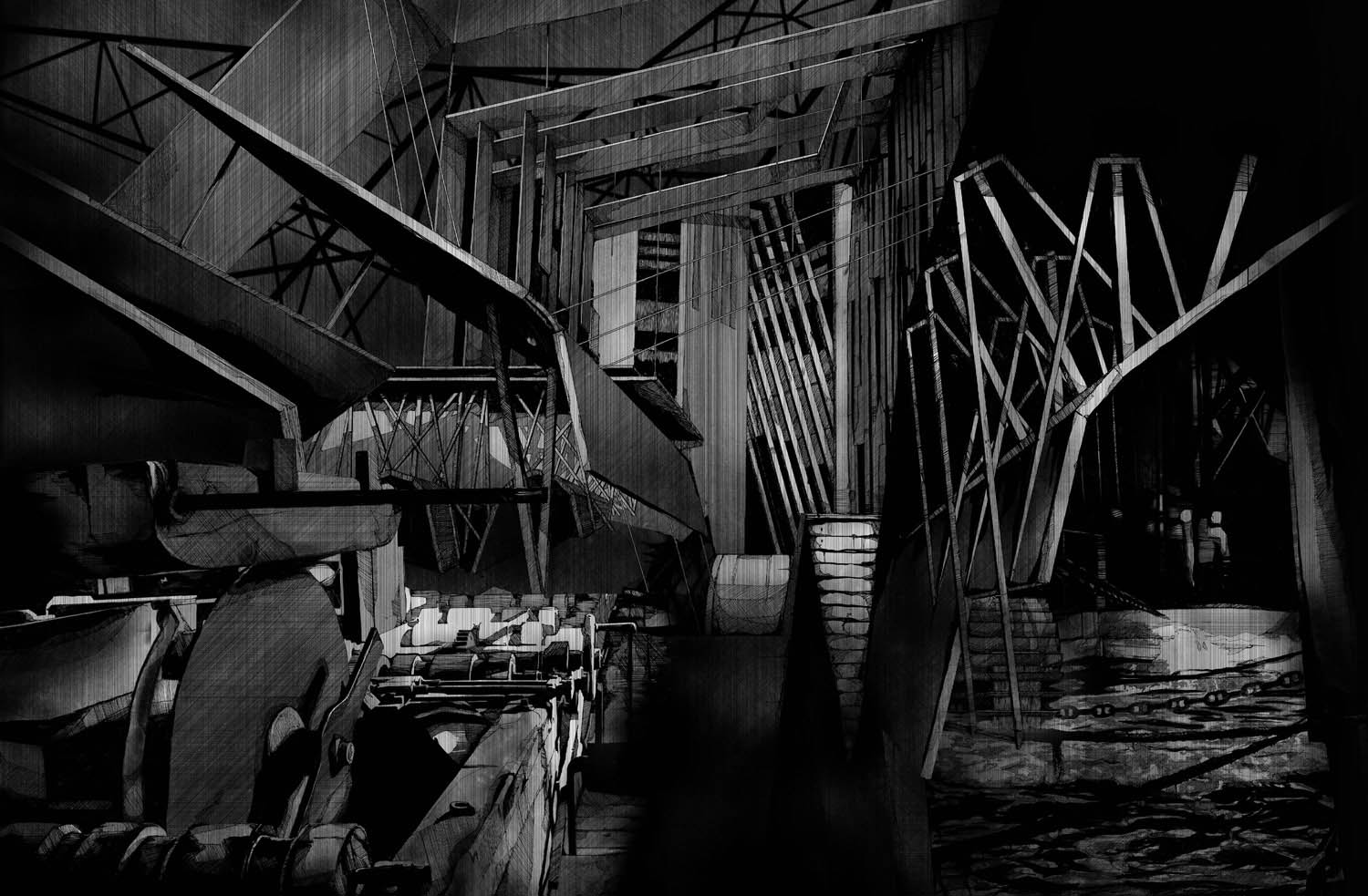
One of my favourite (hand drawn) student projects of the year;
Tom Noonan (Bartlett)
Tom Noonan (Bartlett)


NAMING ARCHITECTURE
introduction
Blur Building. Blossom House. The Gherkin. Names greet, introduce, define and differentiate architectural works. This literature review locates a discussion on the connection between building name and building meaning in relation to established knowledge. In this paper, name refers to the title given to a building by the architect or a title which becomes common to social discourse, and which does not refer solely to the ownership of the building. To ensure that the name remains embedded in its larger context of signification I conceptualise a relationship between myth (narratives that supply frameworks of meaning) and symbol (visual abbreviations of those narratives) in conjunction with which name can be defined as a visual metaphor in which meaning can reside. Literature is sourced from linguistics, semiology and architectural theory. The paper identifies and critically reviews relevant literature surrounding major architectural concepts of language, representation, sign, and metaphor in order to determine a position for future comment on the act of naming buildings, and to suggest a framework for theorising the name.
on the language-architecture foundation
The theoretic development of the built environment has often considered architecture as language. (Summerson 7) Engagement with this paradigm from the divergent post-critical paradigm we are currently situated in requires a tentative return to a moment in history when architecture still had philosophical ambitions and held language up to itself as a mirror. Fundamentally, the language-architecture association examines how architecture meets and knows itself. The literary gaze of architecture traces two pathways. The first aims to understand language’s laws of operation as a scientific system and guide architectural production. It is exemplified by Derrida’s Grammatology. (Derrida, On Grammatology 27) The second explores the premise that all social practice can be understood as meanings, significations, and systems of exchange between objects and is manifest in architectural evaluation. (Coward and Ellis 1)
Subscribe to:
Posts
(
Atom
)
