Showing posts with label Art. Show all posts

TREADMILL

Gerhard Richter, Ruhrtalbrucke (Ruhrtal Bridge)
1969, Oil on Canvas  

 who are you going to be when all this clay flowing through you has
finally become
form, and you catch a glimpse of yourself at daybreak,
...what was it you were told to
accomplish?
- Jorie Graham, Treadmill.


VIOLA


Because you can't not have seen it.

PROJECTED PASTS

New Zealander Mike Hewson is an engineer by training, yet is about to give up his job in Australia to move back to New Zealand and pursue his artistic practices, which until now have been a sideline, full time. And it's a good thing too!
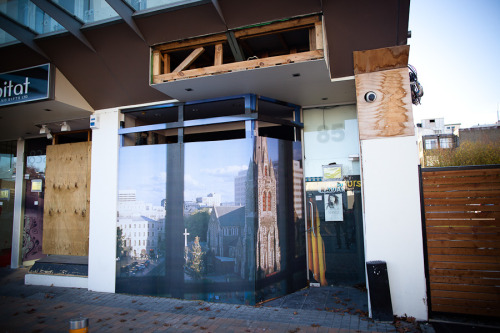
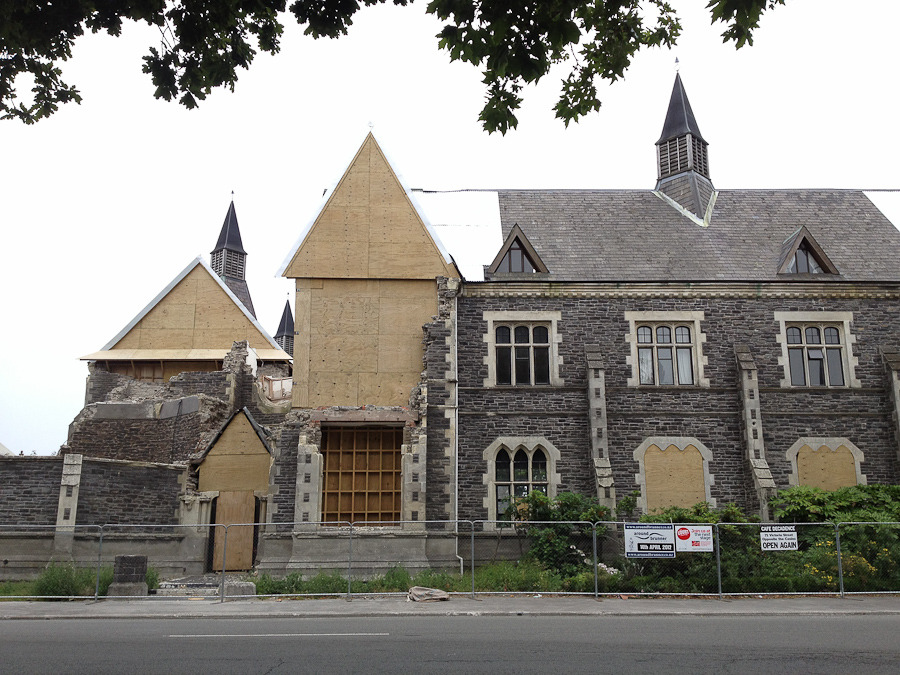
His most recent installation works are hauntingly beautiful: crisp, blue and sepia-toned photos of what was are projected onto the urban gap spaces left in the wake of the Christchurch earthquakes.
At re:Start Cashel Mall, the aptly titled "View from Studio" projects what was once the outward view onto what was once the window, asking by-passers to consider a smaller moment of what was touched by the iconic Cathedral.
Nearby, the former Christchurch Normal school, which is soon to be demolished, is re-inhabited by vivid photographs of the artists who once lived and worked there. Architecturally, I am also quite enamoured with how the plywood, onto which Hewson projects, sits within the existing structures. This kind of honest approach to time and destruction, rather than merely demolishing, would make for a beautiful city. The simple material infill marks, rather than attempts to erase the pain and destruction.
You can follow Mike's work as he progresses into full-time artist  here.


PAPER GENTLEMEN


Paper Gentlemen from Stephen McCullough on Vimeo.

Outside studio.

TEXTILE FIELD


SPLASHING

Richard Serra, Splashing

In Splashing by Richard Serra (1968), the process of creation is embodied in the work: hardened lead thrown against the base of a wall when molten. Once solidified, the viewer is invited to reconstruct the action in their mind.

NEITHER NOR

El Lissitzky, The Proun Room

 (neither elevation nor axonometric)

Also, hanging out at Tate Papers today, I uncovered, among another things, this paper from 2005: Uncovering Professionalism in the Art Museum: An Exploration of Key Characteristics of the Working Lives of Education Curators at Tate Modern


WANDSTUCK

 
KARIN SANDER
 
Wandstück, 1985–86
Akademie der bildenden Künste Stuttgart
Wandfarbe geschliffen
21 x 29,7 cm
courtesy of Sassa Trülzsch, Berlin

LTL

A staircase-reception desk that I rather enjoy, swiped from arch daily's article on LTL Architects' Arthouse at the Jones Center today. 
And then there is this gallery wall:

And a rooftop garden/cinema to top it all off!


+ WORLD, + SELVES, + SUN.

Cotton and silk thread on cotton batting backed with muslin. 6 ft h x 8 ft w.
Cotton and silk thread on cotton batting backed with muslin. 

Jen Bervin, I am certain I haven't seen anything quite this wonderful in quite a while. Then again, I am a Dickinson lover from way back. I quote:
"
Emily Dickinson avoided publication, calling it “the auction of the mind,” but penned nearly 1700 poems in her lifetime. Readers are familiar with her characteristic dashes, but fewer have seen her equally ubiquitous crosses (+ marks) or the variant words to which they correspond because they are rarely reflected in print editions.
The variant words are preceeded by the + mark and often appear listed in clusters after the poem but before the horizontal line Dickinson drew to signal the end of a poem. To read the variants, you move backwards through the poem trying to find the point of insertion, the corollary word or phrase (preceeded by a +) that the variants refer to in the poem. They are sometimes quite close in meaning to the marked word, but in other instances, they are as far ranging as "+ world, + selves + sun."
The Composite Marks of Fascicle 16. 6 feet high x 8 feet wide. 
Cotton and silk thread on cotton batting backed with muslin.

More after break.

ESSAYING ETHICS


Lothar Baumgarten, Tetrahedron, 1968. 

Joshua Fausty at Afterall has written a piece Trinh T. Minh-ha and her critical/creative methodologies which reflect the path that, presently, my thesis is seeming to follow. I've reproduced the whole article here, with my own emphases and notes embedded. You can find a link to the original here. Since I was in a stumbling mode, I also stumbled across Cornelia Lauf's musings On Language and the Public Art of Lothar Baumgarten, a beautiful engaged article with equal pertinence to my questions of critical language and sociality. She includes a favourite quote from Baumgarten which I had near forgotten: 'You cannot reflect your own society, unless you know a society that is remote from it. To know that society, you don't want to walk into it, get a PhD and turn the page. You have to jump into the bushes, almost naked, as I did.'


Trinh T. Minh-ha, Reassemblage, 1982, 16mm film, 40min, stills. Courtesy Moongift Films 

Trinh T. Minh-ha Essaying Ethics

Writing's slippery, mysterious, protean quality gives it a freedom and efficacy always tempered by specific social and historical settings. Like speaking, acting and teaching, writing creates contexts - and there is no end to context-making. Trinh T. Minh-ha's essay-writing is a clear example of this: through the performance of feminist, postcolonial and post-structuralist theories of language, subjectivity and power, her work reveals that writing constructs its own contexts, and cannot be trusted to illuminate without confusing, to disclose the truth without concealing it. Trinh's intellectual history and artistic production emerge in and out of a multiplicity of national and disciplinary contexts. Born in 1952 in Vietnam and educated there and in the Philippines, Trinh emigrated to the United States in 1970 where she studied French literature, music and ethnomusicology at the University of Illinois, Urbana-Champaign. Trinh is currently Professor of Women's Studies and Rhetoric (Film) at the University of California, Berkeley. Her work with theory, poetry and experimental film centres around a reflection on language and identity - a reflection that emerges through literary performances, most explicitly developed in her pointedly essayistic essays on art and criticism.1

SHE CAME IN THROUGH THE BATHROOM WINDOW

Richard Wilson removed a section a gallery window and brought it into the galllery space. Is was then positioned so as to occupy the greatest part of the 'interior' of the gallery. It is clothed in folded, rubberised fabric.
- Matt's Gallery, London, 1989

IT TREMBLES TO CARESS THE LIGHT

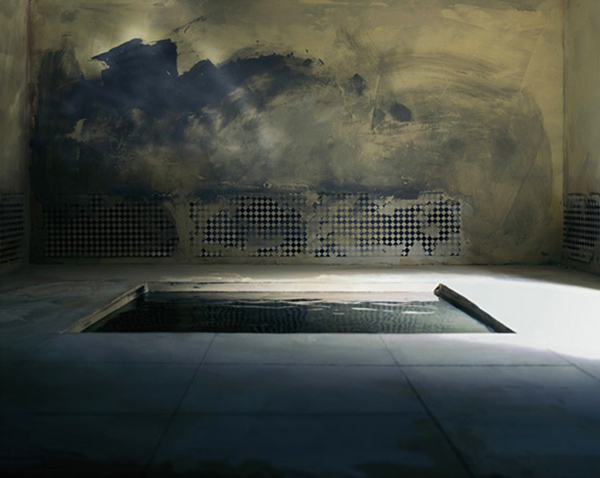
James Casebere: La Alberca, 2005/2006

Photo: courtesy Goetz Collection 
Epilogue 


Those blessed structures plot and rhyme-
why are they no help to me now
i want to make
something imagined not recalled?
I hear the noise of my own voice:
The painter's vision is not a lens 
it trembles to caress the light.
But sometimes everything i write
With the threadbare art of my eye
seems a snapshot 
lurid rapid garish grouped 
heightened from life 
yet paralyzed by fact.
All's misalliance.
Yet why not say what happened?
Pray for the grace of accuracy
Vermeer gave to the sun's illumination
stealing like the tide across a map
to his girl solid with yearning.
We are poor passing facts.
warned by that to give
each figure in the photograph
his living name.

-
robert Lowell

The painter's vision is not a lens except, in the case of James Casebere, when it is. At the same time, it is 
relatively easy to say that his images are heightened from life/yet paralysed by fact. His images trounce the real, they are contaminated by fiction. Is it photo, is it painting? The illumination characteristic of his work is at its most ambiguous in La Alberca. Here, the combination of the abstract, shallow reflective pool of water melts all solidity, returning the physical to its liquid state. The source of illumination is not clear - we are contained in the gestural space.

Flooded Hallway 1999 - Casebere

Discussing La Alberca in terms of Lowell's Epilogue points to a perceived correlation between Vermeer and Casebere. It is notable that Vermeer's work nearly always contains a window - an explicit announcement of the how and why light enters. Casebere, conversely, is not concerned with the entry of light, but with the what the illumination allows. However, this distinction is not as clear as it might appear. Both artists are obsessed with how light returns the eye to reality - both artists tremble to caress the light. For Vermeer, painting the incredibly everyday Milkmaid was a subject of both stark reality and highly institutionalised myth. His illumination works to bring together these two isolated views. For Casebere the same is true - light folds together the reality of space and the myth that physical material alone is form giving.

WANDERS


I also adore his 'Nomad Minimale,' which, perhaps having just seen Walking Piece installed in Monet's garden in Giverney, reminds me of Monet's famous Haystack paintings. They too, in a strange cyclic way, were nomadic.

Haystacks at Giverny, the evening sun. 
1888. Museum of Modern Art, Saitama

TRAVELS


This article at UrbanTick describes this Parisian time lapse by Luke Shepard, entitled 'Le Flaneur' as Debordian, or Situationist.  However,  Le Flaneur, the original, is of course Baudelairean (I have included the poem, A une passante, in French and English after the page break), and embodies quite a different perspective and way of engaging with the city. There is a very interesting article here about the flaneur as it moves into Benjaminian terms. Also, though I like the xx, I prefer the film without sound, without climax, with the images alone telling the tale of how time passes and shifts and speeds to the eye, rather than the images conforming to the rhythms and climaxes of the external song. 

In other armchair travels, I have discovered the newly released Google Art Project and am, as many others, utterly enamoured. 


ANATOMISING


Brian Dettmer, to coin a term, 'anatomises' books. Carving into the text, he reveals inner hidden systems - drawing correlations through and outside the pages rather than simply across. I am perhaps a bit late in stumbling across his work - however it is still stunning. It is reminiscent of a project I saw at the Bartlett a few years ago which I will endeavour to find and post here.
Related Posts Plugin for WordPress, Blogger...