Showing posts with label Roland Barthes. Show all posts
Showing posts with label Roland Barthes. Show all posts
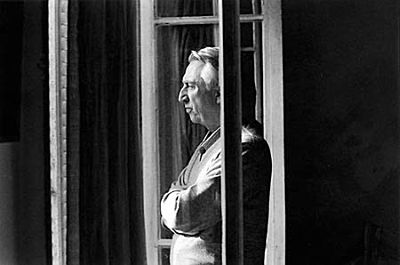

PARISIAN

via James Highman Fine Art
And...http://www.ubu.com/aspen/aspen5and6/threeEssays.html#barthes
And...http://www.ubu.com/aspen/aspen5and6/threeEssays.html#sontag
IRE


Beyond Reality
Ludovico Pratesi
In a passage of La Camera Lucida, his famous essay entirely centered on photography, Roland Barthes talks about the subversive character of this expressive technique which reaches its climax, “not when it frightens, repels or even stigmatizes, but when it is pensive, when it thinks”.
It is an expressive language which not only corroborates reality through images, but it is also able to evoke other possibilities of perception of the photographed subject through different paths of interpretation, transcending the visible to suggest terrains, which are different and of a conceptual, poetic or philosophical nature.
HOW TO MOURN
How to Mourn
- A review of Barthes' beautiful meditation on the loss of his mother entitled 'Mourning Diary'
See also:
- A review of Barthes' beautiful meditation on the loss of his mother entitled 'Mourning Diary'
See also:
WHAT IS A PIECE OF RESEARCH?
"What is a piece of ‘research’? To find out we would need to have some idea of what a ‘result’ is. What is it that one finds? What is it that one wants to find? What is missing? In what axiomatic field will the fact isolated, the meaning brought out, the statistical discovery placed?
No doubt it depends each time on the particular science approached, but from the moment a piece of research concerns the text (and the text extends very much further than the literary work) the research itself becomes text, production: to it, any ‘result’ is literally im-pertinent.
Research is then the name which prudently, under the constraint of certain social conditions, we give to the activity of writing: research here moves on the side of writing, is an adventure of the signifier."
- Barthes 1977, 197-198.
Yes - the question is both urgent and valid - but from where, writes Walker, will the Barthesian mythologists who will examine this question come?
I come from architecture, but as this type of mythologist I must be vigilant with respect to my own motives and those of the institution that sustained my work.
No doubt it depends each time on the particular science approached, but from the moment a piece of research concerns the text (and the text extends very much further than the literary work) the research itself becomes text, production: to it, any ‘result’ is literally im-pertinent.
Research is then the name which prudently, under the constraint of certain social conditions, we give to the activity of writing: research here moves on the side of writing, is an adventure of the signifier."
- Barthes 1977, 197-198.
Yes - the question is both urgent and valid - but from where, writes Walker, will the Barthesian mythologists who will examine this question come?
I come from architecture, but as this type of mythologist I must be vigilant with respect to my own motives and those of the institution that sustained my work.
NAMING ARCHITECTURE
introduction
Blur Building. Blossom House. The Gherkin. Names greet, introduce, define and differentiate architectural works. This literature review locates a discussion on the connection between building name and building meaning in relation to established knowledge. In this paper, name refers to the title given to a building by the architect or a title which becomes common to social discourse, and which does not refer solely to the ownership of the building. To ensure that the name remains embedded in its larger context of signification I conceptualise a relationship between myth (narratives that supply frameworks of meaning) and symbol (visual abbreviations of those narratives) in conjunction with which name can be defined as a visual metaphor in which meaning can reside. Literature is sourced from linguistics, semiology and architectural theory. The paper identifies and critically reviews relevant literature surrounding major architectural concepts of language, representation, sign, and metaphor in order to determine a position for future comment on the act of naming buildings, and to suggest a framework for theorising the name.
on the language-architecture foundation
The theoretic development of the built environment has often considered architecture as language. (Summerson 7) Engagement with this paradigm from the divergent post-critical paradigm we are currently situated in requires a tentative return to a moment in history when architecture still had philosophical ambitions and held language up to itself as a mirror. Fundamentally, the language-architecture association examines how architecture meets and knows itself. The literary gaze of architecture traces two pathways. The first aims to understand language’s laws of operation as a scientific system and guide architectural production. It is exemplified by Derrida’s Grammatology. (Derrida, On Grammatology 27) The second explores the premise that all social practice can be understood as meanings, significations, and systems of exchange between objects and is manifest in architectural evaluation. (Coward and Ellis 1)
Subscribe to:
Posts
(
Atom
)
