Showing posts with label poetry. Show all posts

I NEED THE SEA


I need the sea because it teaches me.  
– Pablo Neruda

Spending this rainy afternoon preparing for the coming summer by reflecting on the last.

These photos where taken sitting in the dunes, staring out into the pacific ocean. If I had swum out in a straight line, the first piece of land I would have set foot on would be South America. The slight swell landing on the shore had travelled thousands of kilometers without interruption; without human recognition.

The weather was moving in from behind me, so as each line of cloud dropped it was as if by surprise. Slowly the horizon swallowed the evening light.

Watching the elements intertwine like that is one of those ever-lasting activities. The kind that remind you you are but a speck in the history of time. The kind that make you wonder about all the other beings who have marvelled at the edge of the world before you.

The repeating patterns of the world pulse through you. That horizon, whether it is distinct, as in these images, or seeping into itself, is eternally calming. I am so looking forward to spending some time swimming in it this Summer.


TREADMILL

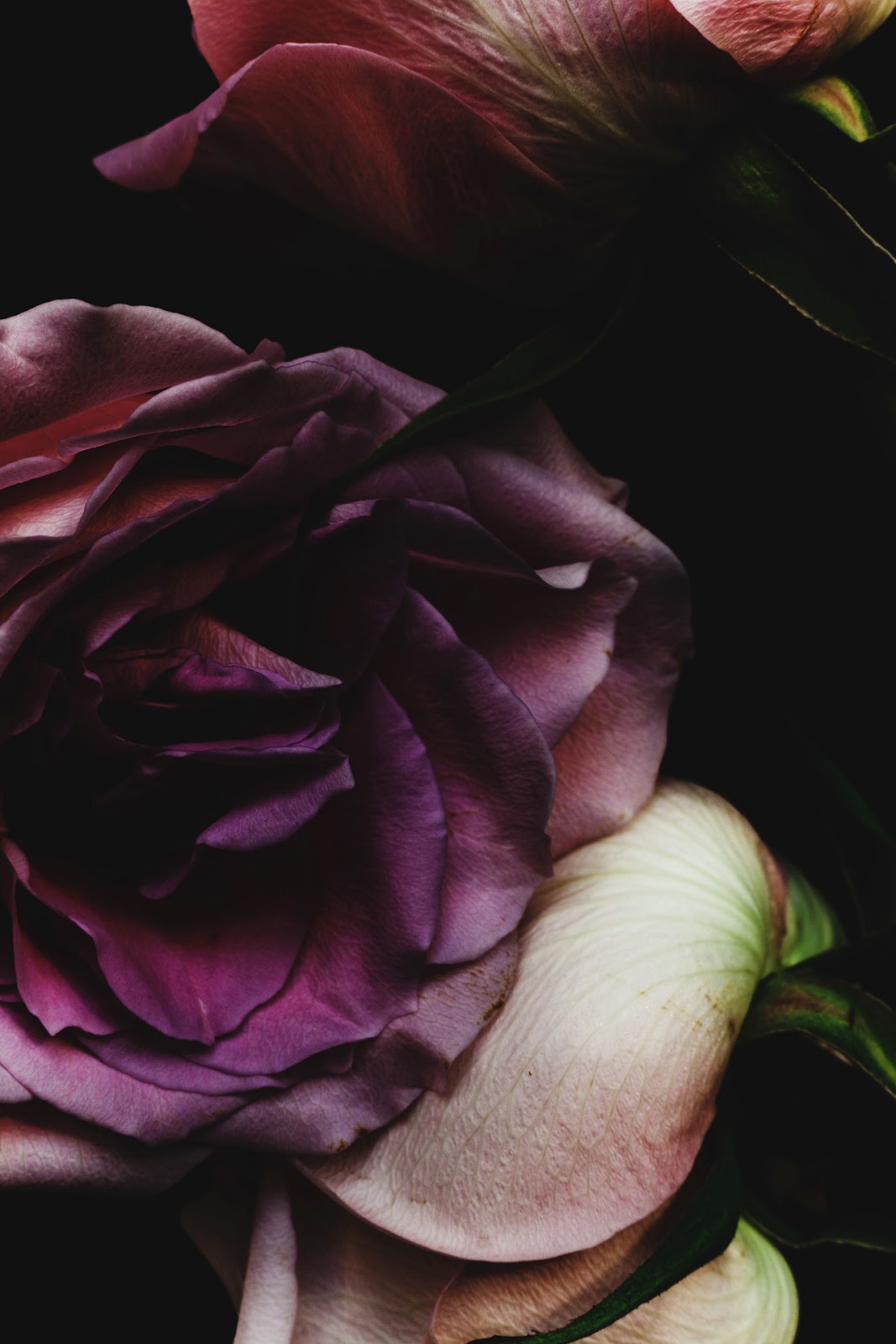
Gerhard Richter, Ruhrtalbrucke (Ruhrtal Bridge)
1969, Oil on Canvas  

 who are you going to be when all this clay flowing through you has
finally become
form, and you catch a glimpse of yourself at daybreak,
...what was it you were told to
accomplish?
- Jorie Graham, Treadmill.


13 WAYS


Thinking about Catton's extraordinary achievement had me reflecting on my brief but honestly exquisite summer time spent flitting in and out of the International Institute of Modern Letters (IIML) here in Wellington.

Earlier this year documentary film-maker Richard Riddiford released his examination of the community that is the IIML and Victoria University Press (VUP, the publishers of The Luminaries). The strength of the community - and its outputs - are evident in various ways throughout the film. 


Particularly poignant is Eleanor Catton’s discussion of her own progression as a writer - analysing herself and the changes which occur to the creative individual during the process of creation. Catton muses on the distance  that can exist between who you are when you compose one work, versus who you become during the next.

For a more in-depth review, see here.


FRUIT & FLOWERS HUNG THICK FALLING


When Fruit and Flowers Hung Thick Falling

- KATIE PETERSON
Never a gardener, she
became interested

in gardening. The dying
are known to

make estranging
decisions

about the disclosure
of information.

Everyone knew
where the report

cards were, but the marriage
license proved difficult

to locate. Tomato
and potato vines crawled

up different stakes
in the same barrel,

and she tended
equally the decorative

plants, the lobelia and alyssum
fringing and clinging to

the edges, in the sun
under a visor

fuzzy with the terry
cloth of enough

vacations to forget
the number, to wear

the lettering 
into half-glyphs insinuating

but not stating
the location of past

happiness. She knelt,
hinged

at the waist,
thrust

her hands in dirt
feeling for roots

even when 
they no longer

needed
tending, even

when fruit and flowers
hung thick falling.

AT THE FISHHOUSES

I have seen it over and over, the same sea, the same,slightly, indifferently swinging above the stones,icily free above the stones,above the stones and then the world.If you should dip your hand in,your wrist would ache immediately,your bones would begin to ache and your hand would burnas if the water were a transmutation of firethat feeds on stones and burns with a dark grey flame.If you tasted it, it would first taste bitter,then briny, then surely burn your tongue.It is like what we imagine knowledge to be:dark, salt, clear, moving, utterly free,drawn from the cold hard mouthof the world, derived from the rocky breastsforever, flowing and drawn, and sinceour knowledge is historical, flowing, and flown.
-  Extract from "At the Fishhouses" from The Complete Poems 1927-1979, by Elizabeth Bishop.

THE DANCE

A middle-aged woman, quite plain, to be polite about it, and
somewhat stout, to be more courteous still,
but when she and the rather good-looking, much younger man
she's with get up to dance,
her forearm descends with such delicate lightness, such restrained
but confident ardor athwart his shoulder,
drawing him to her with such a firm, compelling warmth, and
moving him with effortless grace
into the union she's instantly established with the not at all
rhythmically solid music in this second-rate cafe, 

that something in the rest of us, some doubt about ourselves, some 
sad conjecture, seems to be allayed,
nothing that we'd ever thought of as a real lack, nothing not to be
admired or be repentant for,
but something to which we've never adequately given credence,
which might have consoling implications about how we 
misbelieve ourselves, and so the world,
that world beyond us which so often disappoints, but which
sometimes shows us, lovely, what we are.


- C.K. Williams 

MAN CARRYING THING

 
 The poem must resist intelligence
Almost successfully. Illustration:

A brune figure in winter evening resists
Identity. The thing he carries resists

The most neccessitous sense. Accept them, then,
As secondary (parts not quite percieved

Of the obvious whole, uncertain particles
Of the certain solid, the primary free from doubt

Things floating like the first hundred flakes of snow
Out of a storm we must endure all night,

Out of a storm of all secondary things),
A horror of thoughts that suddenly are real.

We must endure our thoughts all night, until
The bright obvious stands motionless in cold.

- Wallace Stevens


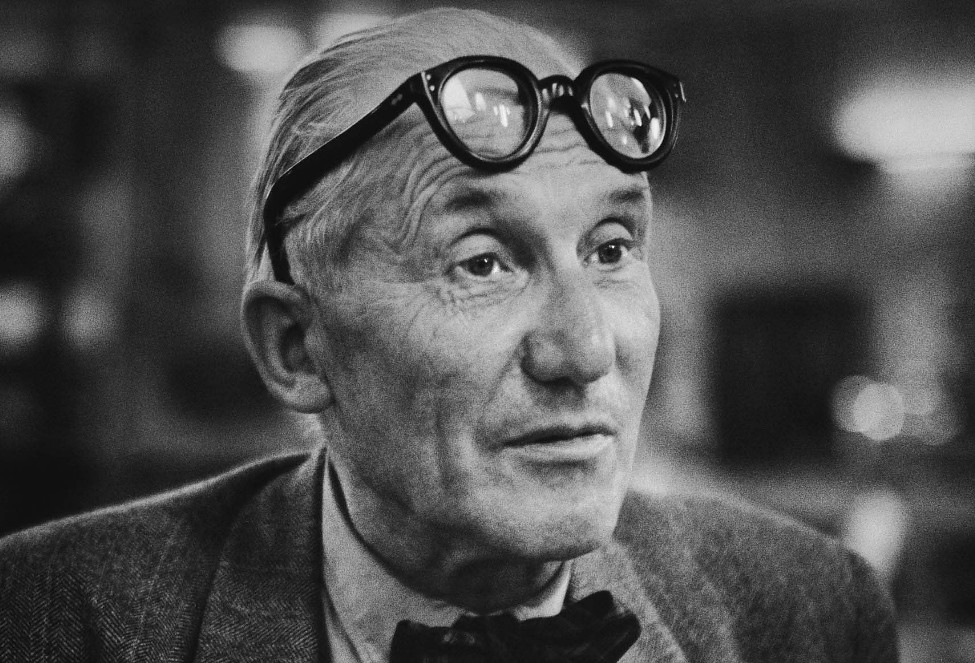
The sonnett and the last two lines which ring true and achingly clear: sometimes you can't deny the power of structure to carry forth meaning (be it in poem, or architecture). 


 Rene Groebli's photography (including Le Corbusier)


IT ISN'T THE SUN

POEM

The minute gears mutely whir. To put your ear
Against it is to put your ear inside it.
It does not tick. It isn’t a heart.
It has no pulse. It isn’t a clock or a wrist.
Scrutiny can coax no secret from it.
There is no hearse with one flat tire
In endless circuit, headlights dispersed
In fog like sunset behind a veil.
A paving stone extends a grave through iron
Gate to a door at home. To knock
Your hand against it puts your hand inside it,
As in a cloud at night the pale moon
Gathers itself outside itself its own light
And glows dimly behind the dust that outshines it.
It has no heat. It isn’t the sun.
It isn’t uncertain. It does not think
About the sun or the distant balls of dirt
And ice that circle closer to the star
With each circuit done. Comet tails
Darkly flowing back as the horse leaps
Forward, straining against the catafalque
All November, predict disaster as grammar
Predicts breath, the need to breathe, or the mind
Must rest. It is its own edgeless disaster.
It is there as if it were not there. Vague
Repetitions haunt the circumference.
To walk out the door is to place your foot
On a stone worn away by another’s foot.
Rumor has it that the sun sends heat in form
Of sight. Watch the ice as it melts
For proof: water pools, darkens on a stone,
Becomes as a shadow on a stone,
A horse’s hoof as it rises off a stone,
Except it rises forever, and the shadow is gone.
Such processes turn the minute gears.
It is not a note in the margin. The margin is
Covered with snow. When the winter fog
Disperses a black horse stands on ice
And cannot move. It is as if a breathless song
Hovered like a veil in the air. The black
Horse’s breath spirals upward like smoke.
Pyre-smoke like a thumbprint as a cloud.
Similes sing mutely in it, likening the unlike.
Mourners name the peace they find and walk
Away. To step into it is to find it missing.
The footprints are before you as you go.

-Dan Beachy-Quick

Yet another of those beautiful seredipitous moments this morning when, having read and loved and re-discovered this poem three times, I read the accompanying interview at How a Poem Happens. Only then did I discover that 'the whole poem arose out of reading Levinas' - Levinas, of course, being the key theoretician guiding my thesis. Moreover, the poem seems intricately related to one of my own entitiled Palms which is long overdue a revision. All that is to say: this poem's really got me. 

THE BUILDING


Higher than the handsomest hotel
The lucent comb shows up for miles, but see, 
All round it close-ribbed streets rise and fall
Like a great sigh out of the last century. 

Extract from a Larkin's Poem 'The Building as included in a lovely article on Philip Larkin and his Libraries over at  Hugh Pearman's Gabion.

THE SEA WALL

Hyperbolic edge to the Ladybower bellmouth, 1935–1944.
(Photograph by Peter Byrne 1991.) 
Found in Andrew Crompton's Three Doors to Other Worlds

The Sea Wall

The wall breaks and enters
the sea, who swallows
the barrier fragment
and slips through the hole like an arm
through a dress sleeve, and smoothes
and smoothes the sleeve to sand we stand on.
We die grain by grain.
How else to make salt
houses for all the creatures
who, as we cannot, go down and
down and open their eyes. 

-Melody S. Gee

MORNING SONG

Love set you going like a fat gold watch.
The midwife slapped your footsoles, and your bald cry
Took its place among the elements.

Our voices echo, magnifying your arrival.  New statue.
In a drafty museum, your nakedness
Shadows our safety.  We stand round blankly as walls.

I'm no more your mother
Than the cloud that distills a mirror to reflect its own slow
Effacement at the wind's hand.

All night your moth-breath
Flickers among the flat pink roses.  I wake to listen:
A far sea moves in my ear.

One cry, and I stumble from bed, cow-heavy and floral
In my Victorian nightgown.
Your mouth opens clean as a cat's.  The window square

Whitens and swallows its dull stars.  And now you try
Your handful of notes;
The clear vowels rise like balloons.

- Sylvia Plath.

Oh Sylvia! That first line, how it grabs me! 

ALIVE

I wish I had known about Robert Montgomery when my first year architecture students were designing billboards for architectural manifestos. Describing himself as 'post-situationist' his poetic texts 'hijack' advertising space, often illegally.The two I have shown above collect sunlight during the day and recycle it at night, glowing.

+ WORLD, + SELVES, + SUN.

Cotton and silk thread on cotton batting backed with muslin. 6 ft h x 8 ft w.
Cotton and silk thread on cotton batting backed with muslin. 

Jen Bervin, I am certain I haven't seen anything quite this wonderful in quite a while. Then again, I am a Dickinson lover from way back. I quote:
"
Emily Dickinson avoided publication, calling it “the auction of the mind,” but penned nearly 1700 poems in her lifetime. Readers are familiar with her characteristic dashes, but fewer have seen her equally ubiquitous crosses (+ marks) or the variant words to which they correspond because they are rarely reflected in print editions.
The variant words are preceeded by the + mark and often appear listed in clusters after the poem but before the horizontal line Dickinson drew to signal the end of a poem. To read the variants, you move backwards through the poem trying to find the point of insertion, the corollary word or phrase (preceeded by a +) that the variants refer to in the poem. They are sometimes quite close in meaning to the marked word, but in other instances, they are as far ranging as "+ world, + selves + sun."
The Composite Marks of Fascicle 16. 6 feet high x 8 feet wide. 
Cotton and silk thread on cotton batting backed with muslin.

More after break.

TAXONOMY AND GRACE AND CLOUD ROOMS

Cloud Room / Bing Bu

The Cloud Room designed by Shanghai-based architect sits on the roof terrace of the National Art Museum of China, a historical landmark from the 1960’s in Beijing.


http://www.openlettersmonthly.com/taxonomy-and-grace/

IT TREMBLES TO CARESS THE LIGHT

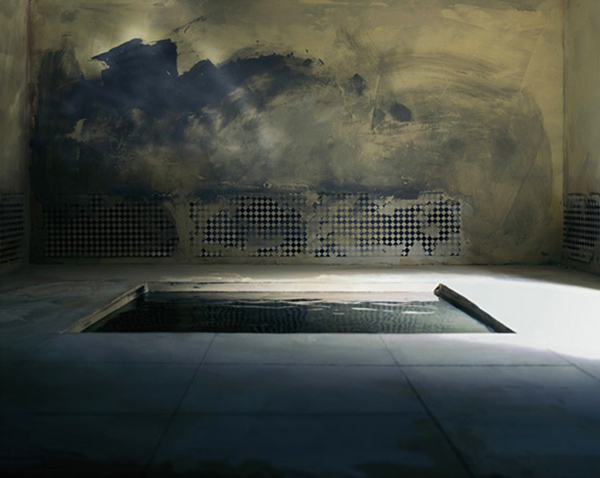
James Casebere: La Alberca, 2005/2006

Photo: courtesy Goetz Collection 
Epilogue 


Those blessed structures plot and rhyme-
why are they no help to me now
i want to make
something imagined not recalled?
I hear the noise of my own voice:
The painter's vision is not a lens 
it trembles to caress the light.
But sometimes everything i write
With the threadbare art of my eye
seems a snapshot 
lurid rapid garish grouped 
heightened from life 
yet paralyzed by fact.
All's misalliance.
Yet why not say what happened?
Pray for the grace of accuracy
Vermeer gave to the sun's illumination
stealing like the tide across a map
to his girl solid with yearning.
We are poor passing facts.
warned by that to give
each figure in the photograph
his living name.

-
robert Lowell

The painter's vision is not a lens except, in the case of James Casebere, when it is. At the same time, it is 
relatively easy to say that his images are heightened from life/yet paralysed by fact. His images trounce the real, they are contaminated by fiction. Is it photo, is it painting? The illumination characteristic of his work is at its most ambiguous in La Alberca. Here, the combination of the abstract, shallow reflective pool of water melts all solidity, returning the physical to its liquid state. The source of illumination is not clear - we are contained in the gestural space.

Flooded Hallway 1999 - Casebere

Discussing La Alberca in terms of Lowell's Epilogue points to a perceived correlation between Vermeer and Casebere. It is notable that Vermeer's work nearly always contains a window - an explicit announcement of the how and why light enters. Casebere, conversely, is not concerned with the entry of light, but with the what the illumination allows. However, this distinction is not as clear as it might appear. Both artists are obsessed with how light returns the eye to reality - both artists tremble to caress the light. For Vermeer, painting the incredibly everyday Milkmaid was a subject of both stark reality and highly institutionalised myth. His illumination works to bring together these two isolated views. For Casebere the same is true - light folds together the reality of space and the myth that physical material alone is form giving.

WHEN INSECTS GROW UP


1.
This place is reserved 
for the bee. At last! The blooming verge

Is his own and he is on it. 
On the verge
of adulthood,

Mother is all:
Legislation! Time isn'tAll sweet tessellations!

And a little hand on 
the shoulder
(You’ll be fine, honey).

Though the distance doesn’t quite drown
Out the drones
he finds

Himself petaled 
with the pleasures of
Independence.

Written after a week in Taupo spent running away from bumble bees and reading Jenny Bornholdt's Summer, which features these beautiful drawings by her husband, and fellow poet, Greg O'Brien.


PLACE AS A PAUSE

Untitled, Untitled and Untitled, from the "Place as a Pause" series, by Marika Asatiani.


'Place as a Pause' reminds me of a book I stumbled across on google books the other day: 'The Small Space of a Pause: Susan Howe's Poetry and the Spaces Between.' I'm hoping to get around to reading the majority of the work at some point. The author, Elizabeth Joyce, unwraps the 'space' of the poetry in such a lucid manner. The poem she has included on the opening page of her introduction is Untitled, 1976, and was previously unpublished. I am at odds as to why she has removed the dashes characteristic of Howe's work (and, for those who are familiar, extremely resonant of Emily Dickinson's punctuation). 


The small space
Of a pause

A haze
Blink into aching lost
Only words remain
If the print is available
The green of a city
A tumble of omens
In a western direction
Narrowing from side to side
Space as emptiness...

Is her theme
The whole page
Not just one part
Positive and negative space
Where?
Or sailed away
In the small space
Of endless possibility


I am also enjoying one of Elisabeth W. Joyce's other works - Cultural Critique and Abstraction: Marianne Moore and the Avant-Garde. More work by Marika after the break.

REPLY

Thinking through body-space relations using James Galvin's Materialism as a base.


If bodies aren't bodies
so much as encounters,
or a phenomena even
more reduced,
Then there's no such thing
As space, though space
Is real, and we
Have not created it.
The self never
located itself.
Here, then,
Is the position of
everything, seeming
to be there.

WAITING FOR SOMETHING VERY NICE TO HAPPEN

Materialism


If things aren't things
so much as happenings,
Or a confluence even
More complex,
Then there's no such thing
As sky, though sky
Is real, and we
Have not imagined it.
The everlasting
Never began.
Everything, then,
Is the direction everything
Moves in, seeming
Not to move.
I'm waiting
For something very
Nice to happen,
And then it happens:
Your long dark
Hair sweeps
Across my chest
Like sweeps of prairie
Rain. Loveliest
Of motion's possessions,
Hold me still.


-James Galvin, bringing me to my knees every time.
Related Posts Plugin for WordPress, Blogger...