Showing posts with label Rachel Whiteread. Show all posts

THREE BATHS


Ether, 1990. 
Valley
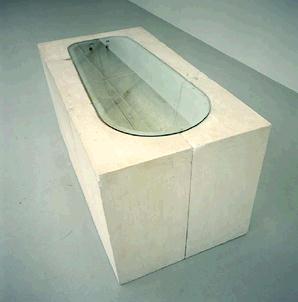
Bath 3

'I made three bath pieces altogether. The first one was called 'Ether' and it had a plughole in it which I drilled out so that there was a hole going through the work. The second one was called 'Valley'. It had glass on top of it, where I wanted to make a space for a body, so the whole thing was like a sarcophagus. I wanted to tap the space so that it felt claustrophobic. The third one, which also had glass on it, had two holes in the glass the two  holes in the plaster, so there was a sense of breathing. I wanted it to have some kind of relief. I remember seeing a documentary about the crypt at Christ Church Spitalfields. They were clearing out lead coffins that were completely sealed, the bodies inside them had deteriorated so much that there was just this lumpy liquid sloshing about inside. And there was one big scare about unleashing the plague and other dreadful diseases. That was something I was thinking about whilst I was making these pieces. I wanted an open one, a sealed one, and one that could breathe." 

- Rachel Whiteread, interview published in William Furlong's Speaking of Art.


SECTION HOUSE


The Cloud Collective's Section House, located on a public green strip in Oisterwijk is just that: a physical, dense section through a typical house. It seems to exist halfway between building site and ruin, halfway between house and playground, halfway between real and unreal. It recalls Whiteread's Ghost - though what is given material presence is not negative space, but the cut of the section. We feel, in it, the resistance of lost matter meeting matter. The drawing is firmly in control of the material - the projected slice is given weight beyond itself. Catherine Ingraham , in an essay titled Losing It in Architecture has called the architectural drawing a lament. Here, indeed, we see the architect's marks stand in for his absent object, calling it into presence. At the same time, the structure breaks no rules, rather, the logic is misapplied, drawn out from itself. The delight is in what the conventional can allow when we engage with it critically. The Section House acts as an operator, what Stan Allen might call a 'transaction' between the abstract realm of geometry and the material stuff of building. 


Whiteread, Ghost

THE PRESENT BODY


Untitled (Cast Iron) 2001


Three thoughtful readings on Whiteread:  
1. Uros Cvoro's 'The Present body, the Absent body, and the Formless' provides a terribly lucid and necessary translation of Whiteread's work in Derridian terms. While Whiteread is typically referenced to Derrida, I have found most links shallow and the critique lacking. (We are typically given a logic somewhat along the lines of Derrida = trace = presence + absence = Whiteread).
2. Damon Hyldreth's 'The Uncanny' discusses Whiteread in Freudian terms based on the double.
3. Doreen Massey's 'Space-time and the Politics of Location' discusses how 'House' functions in social terms.


UNTITLED (WHITEREAD)

 Untitled, 2005. From Whiteread's 'Postcard' series.


In this 'Postcard' series, Whiteread uses a hole punch to cut out negative spaces in the rooms, capturing the three-dimensional concerns of her sculptural form in a two-dimensional manner. The well-known touristic images are obscured by the cluster of circular abscesses, and they become ambiguous.  More of Rachel Whitereads' drawings at the Tate Britain courtesy of the Guardian here, with accompanying article here


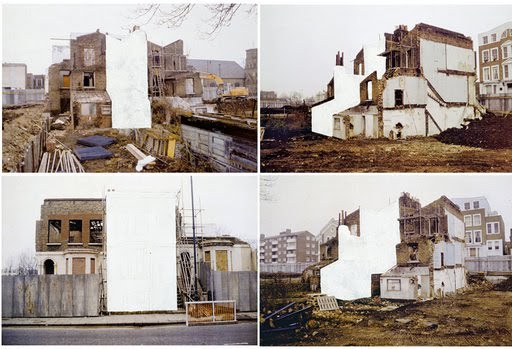
Alongside the postcards are a collection of pseudo-technical drawings, including the revealing 'Study for "House"'. In this work, Whiteread uses an everyday and meaning-laden medium - correction fluid, or 'twink' - to simultaneously create and erase. The house is 'corrected' into a 'pure' whiteness, it becomes absent, yet at the same time, we are more aware of the space the object occupies after the 'intervention'. White is at once pure and ghostly, the house in the images becomes both nothing and, oddly, sky. 


Study for "House", 1992

Related Posts Plugin for WordPress, Blogger...