Showing posts with label society. Show all posts

POST NOW


Open publication - Free pu blishing - More architecture

rcc studio #01 - [from] crisis [to]

Some really interesting pieces on the relationships between the built environment and the notion of crisis, pertinent with my Masters thesis research this year which began with an examination of the continual call of 'crisis' within architecture and linked this call to 'external' crises, be they ecological, economic or political.


I am particularly drawn to Ramiro Aznar Ballarin's 'Mapping London Crisis: The relationship between outbreaks and riots.' It provides analysis and spatial considerations which seem to give more weight to the recent President's Medal Award winning student project robots of Brixton, in which Kibwe Tavares re-examines the 1980's Brixton riots for future architectural (and robotic) potency. The admittedly incredible film accompanying the project is below.


Robots of Brixton from Kibwe Tavares on Vimeo.

ON THESES and REMS


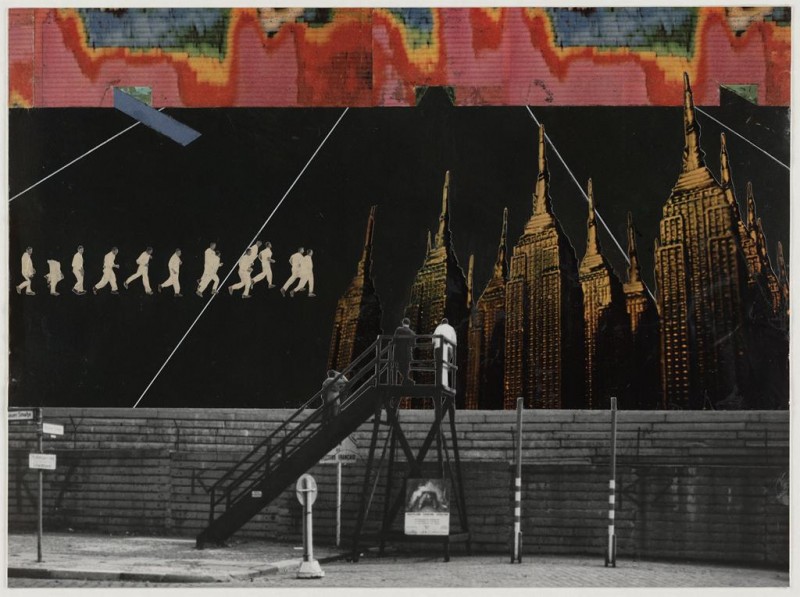
On June 17, 1979, Eija-Riita Eklaf, a Swedish woman, married the Berlin Wall at Grosse-Ziethener Strasse, taking Wall Winther Berliner-Mauer as her name. The final piece of heroic modernist architecture, the Berlin Wall was constructed just as the movement’s Utopian political ambitions had begun to wane. By then, with the eastward spread of modernism during the Khrushchev years, the ideological distinctiveness of modernity had come to an end, making East-West, modern-antimodern harder to distinguish. Still, the architects of the Berlin Wall hoped it would change society.

ESSAYING ETHICS


Lothar Baumgarten, Tetrahedron, 1968. 

Joshua Fausty at Afterall has written a piece Trinh T. Minh-ha and her critical/creative methodologies which reflect the path that, presently, my thesis is seeming to follow. I've reproduced the whole article here, with my own emphases and notes embedded. You can find a link to the original here. Since I was in a stumbling mode, I also stumbled across Cornelia Lauf's musings On Language and the Public Art of Lothar Baumgarten, a beautiful engaged article with equal pertinence to my questions of critical language and sociality. She includes a favourite quote from Baumgarten which I had near forgotten: 'You cannot reflect your own society, unless you know a society that is remote from it. To know that society, you don't want to walk into it, get a PhD and turn the page. You have to jump into the bushes, almost naked, as I did.'


Trinh T. Minh-ha, Reassemblage, 1982, 16mm film, 40min, stills. Courtesy Moongift Films 

Trinh T. Minh-ha Essaying Ethics

Writing's slippery, mysterious, protean quality gives it a freedom and efficacy always tempered by specific social and historical settings. Like speaking, acting and teaching, writing creates contexts - and there is no end to context-making. Trinh T. Minh-ha's essay-writing is a clear example of this: through the performance of feminist, postcolonial and post-structuralist theories of language, subjectivity and power, her work reveals that writing constructs its own contexts, and cannot be trusted to illuminate without confusing, to disclose the truth without concealing it. Trinh's intellectual history and artistic production emerge in and out of a multiplicity of national and disciplinary contexts. Born in 1952 in Vietnam and educated there and in the Philippines, Trinh emigrated to the United States in 1970 where she studied French literature, music and ethnomusicology at the University of Illinois, Urbana-Champaign. Trinh is currently Professor of Women's Studies and Rhetoric (Film) at the University of California, Berkeley. Her work with theory, poetry and experimental film centres around a reflection on language and identity - a reflection that emerges through literary performances, most explicitly developed in her pointedly essayistic essays on art and criticism.1

What is the position of the work within the relations of production of its time? - Benjamin, A as P.

Add caption

The cycle of
production       -       distribution       -        consumption
that the institution of architetcure may be seen to be trapped in asks us to consider the way in which architecture's role in society is percieved and defined by that very society - in the age of mass (re)production and the culture industry.
Related Posts Plugin for WordPress, Blogger...