Showing posts with label space. Show all posts

CELLO IN THE CHARRED CHAPEL


Sometimes you come across someone doing something that makes you sigh. 

German-Korean musician Isang Enders' rendition of Bach’s Cello Suite No. 1 within the sacred, charred interior of Peter Zumthor’s Bruder Klaus Field Chapel is one of those moments you can't help but wish was quietly, selfishly your own. 

It's been a long time since I list picked up a bow and drew it across the strings of my cello. Re-establishing my love for playing that deep, aching instrument has been on my list for quite a while now. But the things that make cellos so human - their size, weight, and equal parts fragility and strength, also make them cumbersome additions to the life of a 25-year old who rents her home and doesn't know where she may move to next.

So in the cello-less meantime, playing the piano in some of my most revered architectural spaces seems like a bucket list worth pursuing. The trick is just going to be getting myself, and the piano, there. 

After that, those encompassing forever moments will come easy.

THE APARTMENT


There is something elusive about spaces which are curated and lived at the same time. We are forever trying to create them, while knowing that in part, they must create themselves. 

Of course The Line manage it, with quintessential ease, in The Apartment: a space for gatherings, launches, and workshops. 

Just perfect.

VIOLA


Because you can't not have seen it.

PAUL HIMMEL


 Paul Himmel. A beautiful, beautiful eye for space, movement, and contrast. 

ZERO

Stumbled across Thomas Kongo's 2009-2010 Zero Project today. Situated within the present-day post-recession scenario, he questions the pervasive architecture desire to build, add, and create: in essence, to deny the zero. Kong explores and proposes an alternate model of architecting which he terms 'Unbuilding' - using the zero, the spaces which are neither positive nor negative -as his model. 

BLURSKING


 - Marjan Colletti

The refurbishment project of a flat in Bolzano/Bozen, Italy, engages in the research undertaken on blur and superposition. Partly sanded glass walls act as physical partitions of functions, yet link the spaces together in a blurred and soft perception of a whole environment. Here, the wall is considered as an intrafacial screen. Rather than blocking the view, the screen allows the gaze into, and contemplation of, spaces semi-visible behind the blurry wall; it monitors events and light conditions and displays them to the other side, affecting that space as well.

The body, always present, vanishes into blurriness and inhabits the wall as well as the space. Fake reflections trigger curiosity, and refractions add layers and layers of details that create a cloudy’ and ‘soft’ experience of the space and of the walls. Other horizontal elements cut through functions and spaces, merging them. They perform the major infrastructural functions of the flat and soften the rigidity of boundary conditions, while relating two spaces contemporarily. Three transparent gaps allow visual penetration through the glass walls: at eye, hand and foot level; all levels allow the soft toys to ‘play’ in the flat. In certain circumstances, these transparent gaps construct fake reflections and projections.

WANDSTUCK

 
KARIN SANDER
 
Wandstück, 1985–86
Akademie der bildenden Künste Stuttgart
Wandfarbe geschliffen
21 x 29,7 cm
courtesy of Sassa Trülzsch, Berlin

BUILDING ROOMS, BUILDING QUALITIES

Allegra Lockstadt's Building rooms, Building qualities  was generated while she was trying to re-acclimatise and re-adjust to American life. Her hope was that by 'building' rooms with patience and solitude, she would be able to 'glean' these traits back off her drawings.

Meanwhile, over a C-Lab, I've been getting very excited (in a thesis-related manner, as is common place these days). Here is an extract from this conversation between Inaba and Jencks.

CJ:          
The problems here are multiple, because we have the ambition on one level to shape the earth. And yet we do not have either the capacity intellectually, economically, or in terms of power, nor do the politicians. We have an earth-shaping rhetoric, but a Boy Scout ideology. And since we control only two percent of building, we get involved in this false consciousness. We have to go along with the great middle-class lie that we can do something about global warming. That’s the biggest, most unbelievable lie of our time, and everybody takes part in it, especially every architect. They have to, because it’s too unthinkable to say, look, we don’t make any difference, we can’t make a difference, and it’s an institutionalized lie to say that we can make a difference. It doesn’t mean that we shouldn’t do all the things that we’re doing to promote an ecological or green architecture, but we should realize that these are gestures of symbolism and art, because we are artists in the end, and if we want to shape the global environment on an ecological level, we have to use our levers of power. And that means: get involved in politics. But, like the rest of the middle class we get involved in this lie that if everybody stays home and uses low-energy light bulbs we can all solve it together.
JI: 
So do you think that architects are destined to be forever Eagle Scouts? Like men dressed up as little boys acting out a role, but never getting our hands dirty?

CJ:
I would say that you have to be an Eagle Scout with irony. I’m asking for a critical irony, because the Boy Scout ideology is the worst form of self-brain washing. My feeling is that architecture culture is bigger than that, and it can stand up and fight off the lie. And we will do that because we all feel it deep down and we want it said.


SHE CAME IN THROUGH THE BATHROOM WINDOW

Richard Wilson removed a section a gallery window and brought it into the galllery space. Is was then positioned so as to occupy the greatest part of the 'interior' of the gallery. It is clothed in folded, rubberised fabric.
- Matt's Gallery, London, 1989

SPEECH BUBBLE

Ana Rewakowicz - Conversation bubble (2008)
via 
archiact
One of many though-provoking, playful spatial interventions.

STUDIO CONSTRUCTS

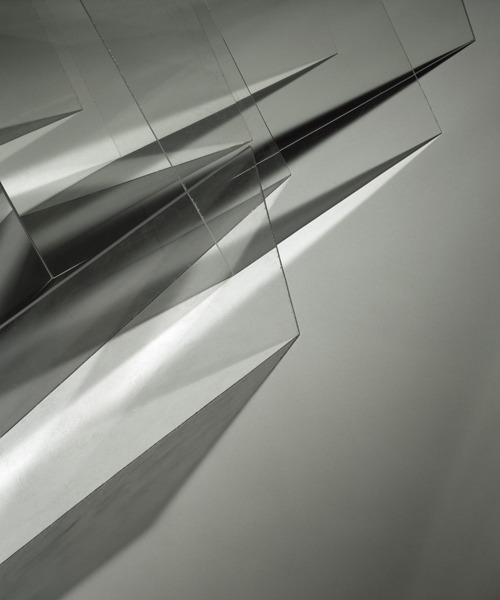
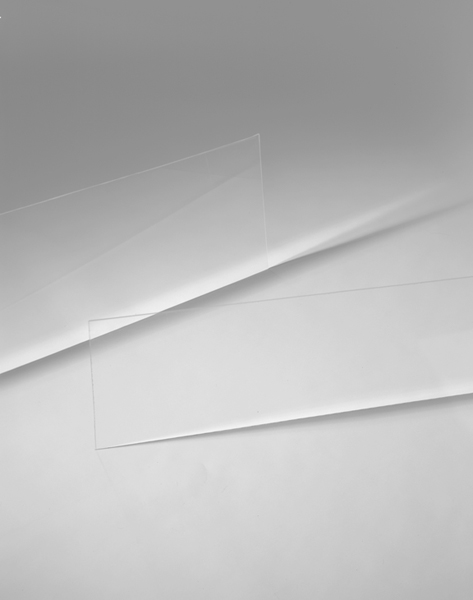
Studio Construct 15, 2007, Archival pigment print, 43.75x53.75 in
Studio Construct 8, 2007, Archival pigment print, 43.75x53.75 in


Studio Construct 17, 2007

"The process of capturing an image through a camera lens requires “an object.” This body of work addresses the representational value of that object. By photographing a transparent plane, and its shadow, familiar association with life experience is eliminated. The result is a “concrete photographic” abstract image." - Barbara Kasten


Regarding her recent solo exhibition, Abstracting…Light, held at the wonderful Almine rech Gallery in France in May-June 2010, Karsten wrote that:
The occurrence of light hitting a plane is distinctive from the recording of the same light thru the lens of a camera. A unique vision occurs through the optical prism that can be captured and ultimately printed, yet cannot be seen by the naked eye. As I directed light on various parts of transparent planes and studied it in the back of a view camera, multicolored abrasions activating the surface appeared. The scratches become a color field of drawing over a normally invisible sheet of plastic. The perception of a ‘thing’, a recordable reality of representation, is basic to the photographic process. In the series “Incidence”, the rendering of light becomes abstract interpretation of surface and form. However, I do not think of the photograph’s construction in terms of abstraction but as an event. Many abstract notions are conjured up as we view this unique recording of materiality. The synthesis of abstract form and our imagination presents a means of seeing the process of lighting. This phenomenon is the subject of my new work and exhibit ‘abstracting…light’.

Barbara Kasten's Construct's are currently on show at London's Carl Freedman Gallery alongside the work of Alexanda Leykauf and at the Cornell Fine Arts Museum in The Edge of Vision Exhibition. The Studio Constructs are perhaps her most muted works - concerned more with the transparency and fleeting physicality of the space as compared with the colour of her earlier work. This depicts a clear turning point for Karsten, from the Moholy-Nagy/Bauhaus influence towards the use of light a la James Turrell. Other artists using similar methods of constructed environments and photography include Eileen Quinlan (whose work I also adore) and Sara VanderBeek

PLACE AS A PAUSE

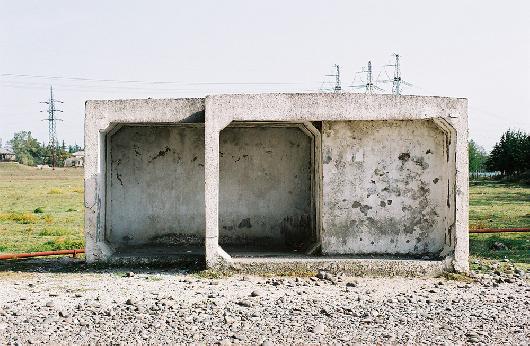
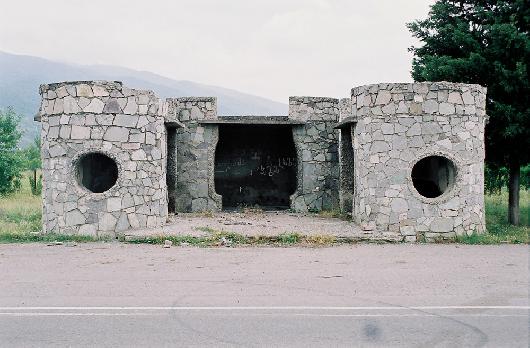
Untitled, Untitled and Untitled, from the "Place as a Pause" series, by Marika Asatiani.


'Place as a Pause' reminds me of a book I stumbled across on google books the other day: 'The Small Space of a Pause: Susan Howe's Poetry and the Spaces Between.' I'm hoping to get around to reading the majority of the work at some point. The author, Elizabeth Joyce, unwraps the 'space' of the poetry in such a lucid manner. The poem she has included on the opening page of her introduction is Untitled, 1976, and was previously unpublished. I am at odds as to why she has removed the dashes characteristic of Howe's work (and, for those who are familiar, extremely resonant of Emily Dickinson's punctuation). 


The small space
Of a pause

A haze
Blink into aching lost
Only words remain
If the print is available
The green of a city
A tumble of omens
In a western direction
Narrowing from side to side
Space as emptiness...

Is her theme
The whole page
Not just one part
Positive and negative space
Where?
Or sailed away
In the small space
Of endless possibility


I am also enjoying one of Elisabeth W. Joyce's other works - Cultural Critique and Abstraction: Marianne Moore and the Avant-GardeMore work by Marika after the break.

REPLY

Thinking through body-space relations using James Galvin's Materialism as a base.


If bodies aren't bodies
so much as encounters,
or a phenomena even
more reduced,
Then there's no such thing
As space, though space
Is real, and we
Have not created it.
The self never
located itself.
Here, then,
Is the position of
everything, seeming
to be there.

TODAY

Jonathan Safran Foer - Tree of Codes.

Other things I've found today: this great greek website, with a particularly well written and well linked article on Iain Borden; this article on the Art of Writing at (ironically?) the Financial Times, which still has that terrible peachy colour scheme of dentist's waiting rooms.


MURMURATIONS

Murmuration presents a Photoworks commission by acclaimed Japanese photographer Rinko Kawauchi (b 1972, Shiga, Japan), made for the Brighton Photo Biennial 2010: New Documents, curated by Martin Parr. 


In other murmurations of the day, a fascinating talk by Iain Sinclair at the AA entitled Ghost Milk (Calling Time on the Age of the Grand Project).

TEN MAPS OF SARDONIC WIT


- Christian Bök

atoms in space now drift
on a swift and epic storm

soft wind can stir a poem

snow fits an optic dream
into a scant prism of dew

words spin a faint comet

some words in fact paint
two stars of an epic mind

manic words spit on fate

SKETCH LIFE


History of Masculinity, Marc Bauer.


Aeolia

Geoff Manaugh, via BLGBLOG, wrote today of a phenomenon which, thought not new persay, poses a whirlpool of exciting - and some terrifying - possibilities for the future of urban architectures. The phenomenon?

The city is generating its own weather.


So have we unintentionally created a real-life version of Virgil's Aeolia, the weather-breeding isle? And if so, will we choose to use such urban architectural meterology to our future urban realm, to weaponise, or will it force us, in combination with the factors of material shortage, global warming, and post-9/11 tall building fear, to pare back our furture development plans?


polish pavilion,Emergency Exit, Venice Biennale 2010

Running a strange parallel, I, as much of the world, have been intrigued by the all-weather-world which occupants must fearlessly submit themselves to - foregoing gravity, support, vision, and all sense of security - at the Polish Pavilion at the Venice Biennale. In fact, the images resonate for me as I imagine the fearlessly, fearfully beautiful future Aeolian city might...
Related Posts Plugin for WordPress, Blogger...