Showing posts with label body. Show all posts
Showing posts with label body. Show all posts

OBLIQUE

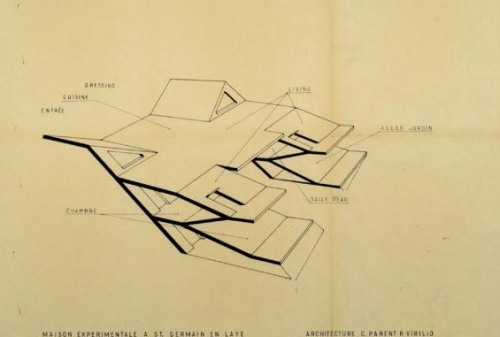

Claude Parent and Paul Virilio in the ‘The Function of the Oblique’ used oblique planes to create architecture of disequilibrium in an attempt to bring the habitat into a dynamic era of the body in movement.
“We wanted above all to create an “ordinary place” where experimentation rreplaces contemplation, where the architecture is experienced through movement and the quality of that movement. The purpose of the oblique was to encourage a constant awareness of gravity, bringing the body into a tactile relationship with the building.”
Habitable circulation - “It is no longer feasible to separate habitation from circulation”.
Paul Virilio and The Oblique - Interview
via catrina stewart
Paul Virilio and The Oblique - Interview
via catrina stewart
BLURSKING


- Marjan Colletti
The refurbishment project of a flat in Bolzano/Bozen, Italy, engages in the research undertaken on blur and superposition. Partly sanded glass walls act as physical partitions of functions, yet link the spaces together in a blurred and soft perception of a whole environment. Here, the wall is considered as an intrafacial screen. Rather than blocking the view, the screen allows the gaze into, and contemplation of, spaces semi-visible behind the blurry wall; it monitors events and light conditions and displays them to the other side, affecting that space as well.
The body, always present, vanishes into blurriness and inhabits the wall as well as the space. Fake reflections trigger curiosity, and refractions add layers and layers of details that create a cloudy’ and ‘soft’ experience of the space and of the walls. Other horizontal elements cut through functions and spaces, merging them. They perform the major infrastructural functions of the flat and soften the rigidity of boundary conditions, while relating two spaces contemporarily. Three transparent gaps allow visual penetration through the glass walls: at eye, hand and foot level; all levels allow the soft toys to ‘play’ in the flat. In certain circumstances, these transparent gaps construct fake reflections and projections.
REPLY
Thinking through body-space relations using James Galvin's Materialism as a base.
If bodies aren't bodies
so much as encounters,
or a phenomena even
more reduced,
Then there's no such thing
As space, though space
Is real, and we
Have not created it.
The self never
located itself.
Here, then,
Is the position of
everything, seeming
to be there.
If bodies aren't bodies
so much as encounters,
or a phenomena even
more reduced,
Then there's no such thing
As space, though space
Is real, and we
Have not created it.
The self never
located itself.
Here, then,
Is the position of
everything, seeming
to be there.
PENCIL ME IN


While Caroline creates a large number of stunning pencil and watercolour fashion-related illustrations, it is her multi-portraits which attract me the most. I'm inspired to get out my coloured pencils again - something I have not done in a while. It is much more difficult to get it right when working in colour, especially with pencil, which is much more indelible than you would think. A taupo plan, perhaps.
GIACOMETTI VARIATIONS


THE PRESENT BODY

Untitled (Cast Iron) 2001
Three thoughtful readings on Whiteread:
1. Uros Cvoro's 'The Present body, the Absent body, and the Formless' provides a terribly lucid and necessary translation of Whiteread's work in Derridian terms. While Whiteread is typically referenced to Derrida, I have found most links shallow and the critique lacking. (We are typically given a logic somewhat along the lines of Derrida = trace = presence + absence = Whiteread).
2. Damon Hyldreth's 'The Uncanny' discusses Whiteread in Freudian terms based on the double.
3. Doreen Massey's 'Space-time and the Politics of Location' discusses how 'House' functions in social terms.


SPACES BETWEEN WORDS

Architecture which is distilled, oblique.
Architecture when, in your 'once upon a time's, you, the students of
inconvenient knowledge, might have turned to the two reflected men and said:
from each vast, collapsing heart, be sure to take meaning but never message, and live!
Live in the spaces between your words.

snake - roche
PERCEPTION IS SYNAESTHETIC
This means that there does not exist any primary isolation between the different senses. The isolation is secondary. We perceive and we may with some difficulty decide thatone part of the perception is based upon the optic impressions. The synaesthetia is therefore a normal situation. The isolated sensation is the product of an analysis. In the scheme of the body, tactile, kinaedthetic and optic impulses can only be separated from each other by artificial methods.
What we have studied is the change in the unity of the postural model of the body by change in the sensation of the tactile and optic sphere. The nervous system acts as a unit accoding to the total situation. The unit of perception is the object which presents itself through the senses and through all the senses. Perception is synaesthetic.
(Schilder 1978: 38-39)
From Elizabeth Grosz's Volatile Bodies.
What we have studied is the change in the unity of the postural model of the body by change in the sensation of the tactile and optic sphere. The nervous system acts as a unit accoding to the total situation. The unit of perception is the object which presents itself through the senses and through all the senses. Perception is synaesthetic.
(Schilder 1978: 38-39)
From Elizabeth Grosz's Volatile Bodies.
THIS BODY IS
 |
Figura X 1996/05 - Vladimir Zidlicky |
The body is what makes a life of a moving in-between.
bodies of writings - thinking about the bi-stable image
In the reader's eye and mind, writing encounters the body of the book. Take the pace of the footsteps, the phenomenological, and you may end up in the body of the house itself. When there, hold the book up to the light. Beside the writer's desk, writing is a prosthetic presence. What happens if you move along the wall? The writing, too, is restless. The line is enfleshed. When there is an expectation of your abilities, all writing is hybrid. All writing is you, embodying your body, the body of knowledge, and itself into a bi-stable image.
relationscapes - on bodies, thoughts, and movement through space
What moves as a body, returns as the movement of thought
-Deleuze
Reading Erin Manning's Relationscapes.
Manning sets out to bridge the gap between thinking/speaking and doing/creating, and in doing so, to challenge the active/passive model of speaker/listener or artist/spectator. One of the major projects on which the book is based, Housing the Body - Dressing the Environment, unpacks the gap between thinking and doing through aligning with Henri Bergson's definition of Embodied Cognition. According to this critical theory, the relation between perception in all its modes is one of reciprocal read-and-return. Manning writes that 'the cross genesis of action and perception opens into thought.' In other words, every perception: a thinking action. Every act: the perception of thought. Furthermore, this relation can be modified via the environment. Architecture not only houses the body, buit also creates modes of embodied experience and thought.
The questions Manning poses range from how does thought work? where does creation begin? what constitutes novelty and what might a politics of movement do to the ultimate question of how can thinking through movement alter the force of thought?
-Deleuze
Reading Erin Manning's Relationscapes.
Manning sets out to bridge the gap between thinking/speaking and doing/creating, and in doing so, to challenge the active/passive model of speaker/listener or artist/spectator. One of the major projects on which the book is based, Housing the Body - Dressing the Environment, unpacks the gap between thinking and doing through aligning with Henri Bergson's definition of Embodied Cognition. According to this critical theory, the relation between perception in all its modes is one of reciprocal read-and-return. Manning writes that 'the cross genesis of action and perception opens into thought.' In other words, every perception: a thinking action. Every act: the perception of thought. Furthermore, this relation can be modified via the environment. Architecture not only houses the body, buit also creates modes of embodied experience and thought.
The questions Manning poses range from how does thought work? where does creation begin? what constitutes novelty and what might a politics of movement do to the ultimate question of how can thinking through movement alter the force of thought?
prosthetic impulses
"culture can be understood as an extension, a protraction, and a projection of the interior of the body itself."
- elizabeth grosz (the prosthetic impulse)
- elizabeth grosz (the prosthetic impulse)
Subscribe to:
Posts
(
Atom
)
