Showing posts with label photography. Show all posts
IT TREMBLES TO CARESS THE LIGHT
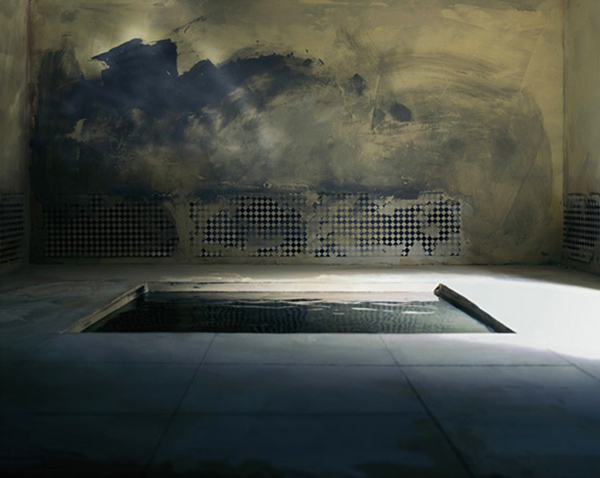
James Casebere: La Alberca, 2005/2006
Photo: courtesy Goetz Collection
Epilogue
Those blessed structures plot and rhyme-
why are they no help to me now
i want to make
something imagined not recalled?
I hear the noise of my own voice:
The painter's vision is not a lens
it trembles to caress the light.
But sometimes everything i write
With the threadbare art of my eye
seems a snapshot
lurid rapid garish grouped
heightened from life
yet paralyzed by fact.
All's misalliance.
Yet why not say what happened?
Pray for the grace of accuracy
Vermeer gave to the sun's illumination
stealing like the tide across a map
to his girl solid with yearning.
We are poor passing facts.
warned by that to give
each figure in the photograph
his living name.
-robert Lowell
-robert Lowell
The painter's vision is not a lens except, in the case of James Casebere, when it is. At the same time, it is relatively easy to say that his images are heightened from life/yet paralysed by fact. His images trounce the real, they are contaminated by fiction. Is it photo, is it painting? The illumination characteristic of his work is at its most ambiguous in La Alberca. Here, the combination of the abstract, shallow reflective pool of water melts all solidity, returning the physical to its liquid state. The source of illumination is not clear - we are contained in the gestural space.
farmer woman (Milk maid) - Vermeer
Discussing La Alberca in terms of Lowell's Epilogue points to a perceived correlation between Vermeer and Casebere. It is notable that Vermeer's work nearly always contains a window - an explicit announcement of the how and why light enters. Casebere, conversely, is not concerned with the entry of light, but with the what the illumination allows. However, this distinction is not as clear as it might appear. Both artists are obsessed with how light returns the eye to reality - both artists tremble to caress the light. For Vermeer, painting the incredibly everyday Milkmaid was a subject of both stark reality and highly institutionalised myth. His illumination works to bring together these two isolated views. For Casebere the same is true - light folds together the reality of space and the myth that physical material alone is form giving.
via Carol Diehl
MINI-CITY
Having seen these tilt-shift photos by Ed McGowan a week or so ago, I was inspired to try my hand at tilt-shifting Wellington. Though I didn't have much time, or really know what I was doing, I was quite excited by the results of my five-minute snap on a rare sunny-and-still(ish) day. The images tend to be more believable as 'miniatures' when taken from above, so I'll have to find more high spots. I'm quite in love with how the water shots turned out.
SEASONS
Ygdrasil, Autumn in Auvergne
Anselm Kiefer, “Ygdrasil, Herbst in Der Auvergne,” 2010, Gouache on Photographic Paper. Courtesy Gagosian Gallery, New York.
Summer in Barjac - The reknowned Orders of Night
Anselm Kiefer, “Sommer in Barjac — Die berĂ¼hmten Orden der Nacht” 2010, gouache on
photographic paper. Courtesy Gagosian Gallery, New York.
"Snow melt in the Odenwald. Goodbye, winter, parting hurts but your departure makes my heart cheer. Gladly I forget thee, may you always be far away. Goodbye, winter, parting hurts."
Work on the book has recently had me engaging in discussion of Heidegger, and I have once again been seeing the world with a tint of Anslem Kiefer to it. The relationship between the two men - and their philosophies - is intriguing in many ways. See here, and of course Michael Biro. I've been musing on it a lot lately, and will continue this blog when I've found the right words. In any case, this book is on my must-acquire list. You can see some of the blood-freezingly-beautiful photography here,I couldn't bring myself to re-post. For now, Kiefer has the most interesting thing to say:
"There is a special border, the border between art and life that
often shifts deceptively. Yet, without this border, there is no art.In the process of being produced, art borrows material from life,
and the traces of life still shine through the completed work of art.
But, at the same time, the distance from life is the essence, the
substance of art. And, yet, life has still left its traces. The more
scarred the work of art is by the battles waged on the borders
between art and life, the more interesting it becomes."
~ Anselm Kiefer
In looking for all-things-Kiefer, I also stumbled across this amazing resource at the University of Minnesota (why have I not heard of robert Stackhouse before!?) and this film by Sophie Fiennes.
Subscribe to:
Posts
(
Atom
)