Showing posts with label object. Show all posts

FOOTPRINT


Also, the incredibly thesis-pertinent inaugural issue of footprint journal:

This inaugural issue of Footprint aims at understanding today’s architecture culture as a negotiation between two antithetical definitions of architecture’s identity. The belief in the disciplinary singularity of architectural objects, irreducible to the conditions of their production, is confronted - in discourse and design - with the perception of architecture as an interdisciplinary mediation between multiple political, economic, social, technological and cultural factors. With the concept of trans-disciplinarity, the negotiation between these two positions is investigated here as an engine of the ‘tradition of the present’ of contemporary architecture - the discourses and designs which emerged in the 1960s and defined orientation points for today’s architectural thought and practice.


The contributions to this issue of Footprint include Wouter Davidts’ analysis of architectural design and discourse as a condition for art; Michael Hays’ examination of narrative as a form of understanding the object of architecture within the forces which it reflects and opposes; Patrick Healy’s reconstruction of Max Raphael’s project of an empirical theory of art and architecture; Mark Jarzombek’s questioning of architecture as a philosophical project; Ákos Moravánszky’s mapping of the multiple interchanges between theory, design, history and education of architecture; Jean-Louis Violeau’s account of the collaborations between architects and sociologists on architectural research in France since the late 1960s.


Issue's editors: Tahl Kaminer and Lukasz Stanek

CARBON DATER

'Time is the water that we exist in like fish. You might say it's oxygen, but I think time really is our element.' - Bill Viola 
“Carbon Dater is a black diamond-tipped carbon pen for writing and illustrating directly into glass… for carbon dating. Specifically – A .30 carat black diamond set in milled brass claw, fixed to a hand-tooled lazer-engraved inanimate carbon rod, presented in an inked 247-piece hinged cardboard box.”Images and text courtesy Sruli Recht

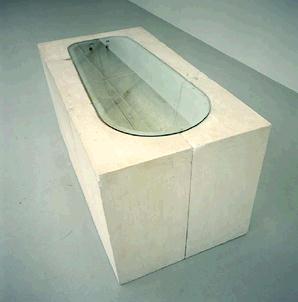
THREE BATHS


Ether, 1990. 
Valley
Bath 3

'I made three bath pieces altogether. The first one was called 'Ether' and it had a plughole in it which I drilled out so that there was a hole going through the work. The second one was called 'Valley'. It had glass on top of it, where I wanted to make a space for a body, so the whole thing was like a sarcophagus. I wanted to tap the space so that it felt claustrophobic. The third one, which also had glass on it, had two holes in the glass the two  holes in the plaster, so there was a sense of breathing. I wanted it to have some kind of relief. I remember seeing a documentary about the crypt at Christ Church Spitalfields. They were clearing out lead coffins that were completely sealed, the bodies inside them had deteriorated so much that there was just this lumpy liquid sloshing about inside. And there was one big scare about unleashing the plague and other dreadful diseases. That was something I was thinking about whilst I was making these pieces. I wanted an open one, a sealed one, and one that could breathe." 

- Rachel Whiteread, interview published in William Furlong's Speaking of Art.


IDEAL CRITICISM

Post-critical theory suggests that THEORY IS DEAD. I propose to address  post-critical theory through a combination of two primary themes: the capacity of architectural criticism to function as critical method, and the development of architectural criticism towards spatial practice.

Drawing in particular on the work of Jane Rendell and John Hejduk on the question of criticism as spatial practice, I will inquire into the status of the architectural object as a site for criticism beyond post-critical thinking.

Two models of architecture-space-writing-criticism which will underly and guide this discussion are:
Henri Lefebrve's triptych of spatial practice, representations of space and spaces of representation and Derrida's parallel triptych of space of writing, space as writing and space as the distance of representation.

It is postulated that the implict idealism of criticism springs from the ambiguity of languge itself. By allowing a slipping of architecture towards critical practice, and criticism into spatial practice, can we 'prevent it [the language of criticism] from becoming the instrument of a sacred rite?' - Manfredo Tafuri

And if so, we find a new way to critique the death of theory as post-critical theory defines it.
Related Posts Plugin for WordPress, Blogger...